
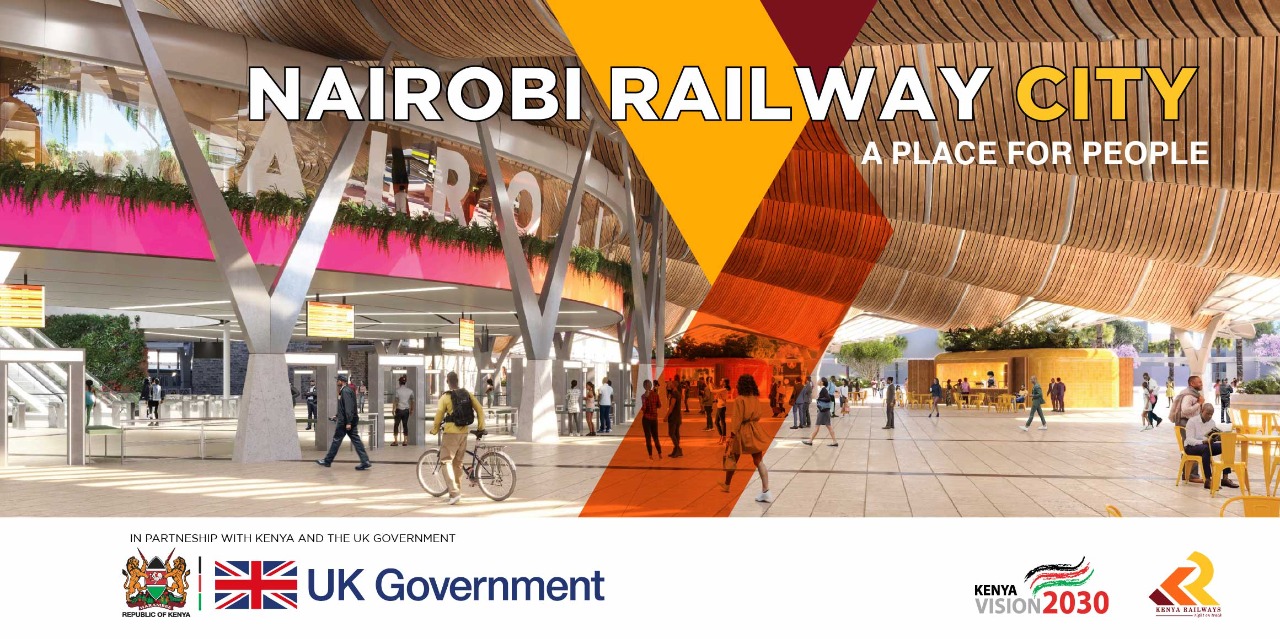
Nairobi Railway City: Redefining the Cityscape and Unlocking Nairobi’s Transport Potential
The Government of Kenya through, Kenya Railways intends to redevelop the Nairobi Central Railway Station and its surrounding areas into a multi-modal, transit oriented, urban development dubbed Nairobi Railway City. The project is of great national significance and forms part of the core strategy for regeneration of Nairobi City, creating equilibrium between social benefits for the city and economic returns.
Positioned as a model for sustainable inner-city renewal, the initiative aims to revitalize the underutilised and congested railway corridor within Nairobi’s Central Business District (CBD). The project’s physical and conceptual nucleus is the historic Nairobi Central Railway Station, a key node in Kenya’s rail network
The project is of Strategic National Importance and forms part of the core strategy for regeneration of Nairobi City, creating equilibrium between social benefits for the city and economic returns.
An elaborate transport infrastructure will provide linkages by establishing the North-South and East-West connection across the current rail infrastructure.
A modernized central station will help ease CBD congestion by accommodating projected daily footfall of 400,000 by 2030 and up to 600,000 by 2045.
It aligns with broader national ambitions such as Kenya Vision 2030, contributing to socio-economic transformation through strategic infrastructure investment and urban planning.
Project Objectives
Support the government’s Bottom-up economic model by:
- Stimulating trade through initiatives such as modern Wakulima market and retail outlets
- Improved mobility through decongestion of roads
- Make the city a livable place through the housing component and renewed real estate development opportunities
- Creation of jobs
- Contribute to reduction of carbon emissions by factoring in climate resilient urban regeneration and low carbon buildings.
The Nairobi Railway City Strategic National Installation and Project Plan (2023-2033)
PRECINCTS
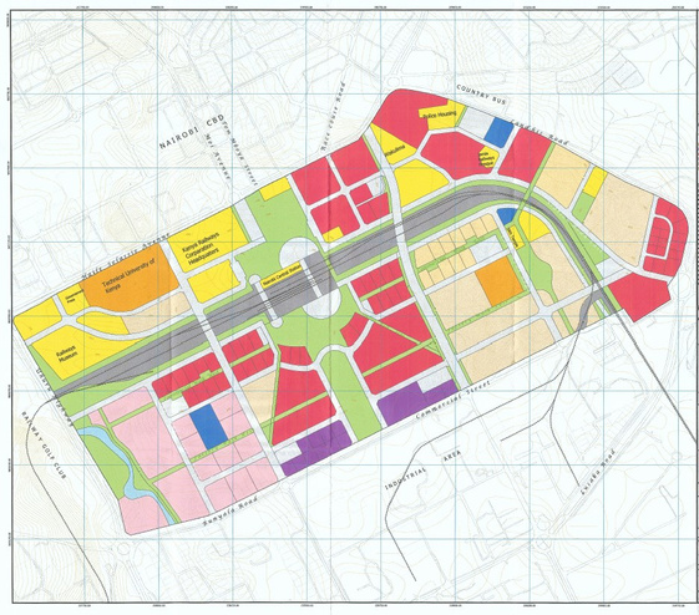
The Nairobi Railway City lies on 438 acres of prime land. It is divided into six (6) precincts each with a specific location character, specific urban function and unique identity. They are:
- Central Station Front Precinct
The heartbeat of the entire development, this is where mobility meets heritage. It features a state-of-the-art multi-modal Central Railway Station, seamlessly integrating SGR, MGR, BRT and Non-Motorised Transport (NMT) infrastructure. This transport hub is surrounded by public open spaces, cultural conservation areas, office and retail developments and civic leisure zones.
- Central Station Back Precinct
A vibrant commercial zone that builds on the momentum of the station to foster land value capture, job creation, and economic growth. It will feature high-density commercial development and mixed-use buildings that support enterprise, logistics and civic services while maintaining walkability and access.
- MICE Core Precinct (Meetings, Incentives, Conferences & Exhibitions)
This precinct is Nairobi’s new international face, a space for global convening, business diplomacy, and cultural engagement. It will host convention centres, hotels, public plazas, and iconic architecture suited for events of national and international stature.
- Commercial Core Precinct
An economic engine that includes Grade A offices, retail arcades, mixed-use towers, and serviced commercial spaces. With street-level commercial vibrancy and flexible workspaces, this core will support Nairobi’s position as a regional financial and commercial capital.
- Market Core Precinct
A socially focused and inclusive urban market precinct, designed to integrate informal trade, cooperative enterprise, and sustainable micro-retail. It emphasizes local economic empowerment while incorporating heritage architecture, public amenities and green spaces to elevate the market environment into a dignified, inclusive commercial zone.
- West Core (Culture, Innovation, Research & Employment Hub)
Envisioned as Nairobi’s intellectual and creative hub, this precinct blends education, innovation, and enterprise. It includes student housing, cultural institutions, innovation labs, co-working spaces, and performance venues therefore positioning it as a launchpad for youth-driven growth and cultural expression.
- Affordable Sustainable Housing
Exemplary residential neighborhood offering residents a complete lifestyle
Concept design
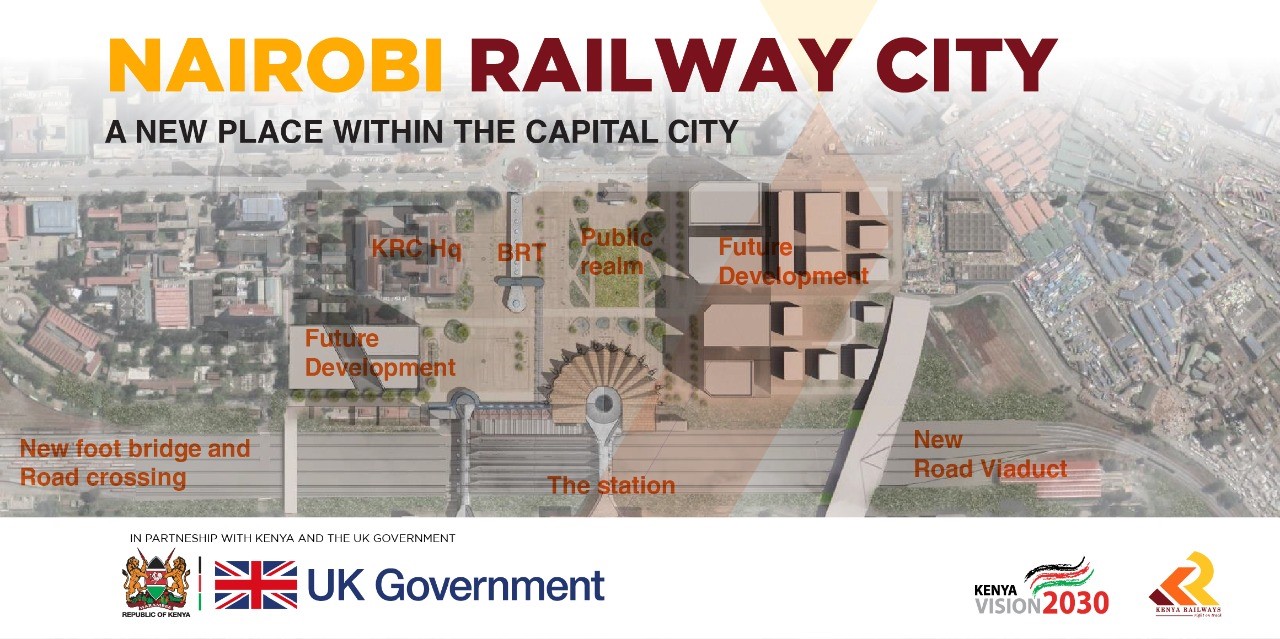 This design was developed in line with industry best practice and guidelines and in line with the
project brief highlighted below:
- Iconic, landmark design with distinctive façades and roof structure that is intimately reflective of Nairobi’s heritage and that of Kenya at-large.
- Incorporate existing heritage station
- 2-storey building – Ground floor to be retail/F&B and other amenities – capable of being used by passengers and occupiers of surrounding buildings. First floor to provide ticket hall and access to platforms
- Provision for future entrance on south side of platforms
- Landscaped, grand landmark public square in front.
- A design compliant with low carbon and climate resilient design principles including efficiency, build-ability, embodies carbon, carbon in use, maintenance, and whole life costs
- A design that consider the opportunities that arise from the stations interface between the railway station and the local community.
- Imaginative solutions that deliver a stress- less experience that enhance the social
value of the station and its surroundings. - Designs that are flexible and adaptable to changes in behaviour, future technical requirements, and rapidly evolving technologies.
- A design that shows how energy and operational maintenance.
- Consideration for the use of durable the materials over the lifespan of the building to
weather and how it matures with age costs will be optimised through the design
UK Government support
Kenya and the UK have a long history relating to railway development, with the UK Government having constructed Kenya’s first railway network in the 1890s.
The UK Government is keen to partner with African countries as part of its mission to become Africa’s investment partner of choice.
At the UK-Africa Investment Summit, held in London on 20th January 2020, the former president of the Republic of Kenya his Excellency President Uhuru Kenyatta, and the former British Prime Minister, Boris Johnson met and discussed the Nairobi Railway City Project. On the back of that discussion Prime Minister Johnson offered Kenya UK Government support to help Kenya take forward the project.
Since early 2020 the UK Government has funded a team of urban development experts to provide relevant Kenyan government agencies involved in taking forward NRC with technical support that has included a review of the master plan, land due diligence, identification of priority projects, a feasibility study and detailed design and associated engineering and costing of the first priority project, a new central Railway Station at the Centre of Nairobi City Centre.
Furthermore, the UK Government through UK Export Finance (UKEF) have signed an MoU with Kenya’s National Treasury and Planning to finance infrastructure projects in Kenya. Railway City is the first mover project under this MoU upon which financing will be unlocked for other
infrastructure projects.
Railway City continues to be an important project in the UK’s strategic partnership with the Government of Kenya and as such continues to enjoy high level political support from both governments.
Central Station & Public Realm
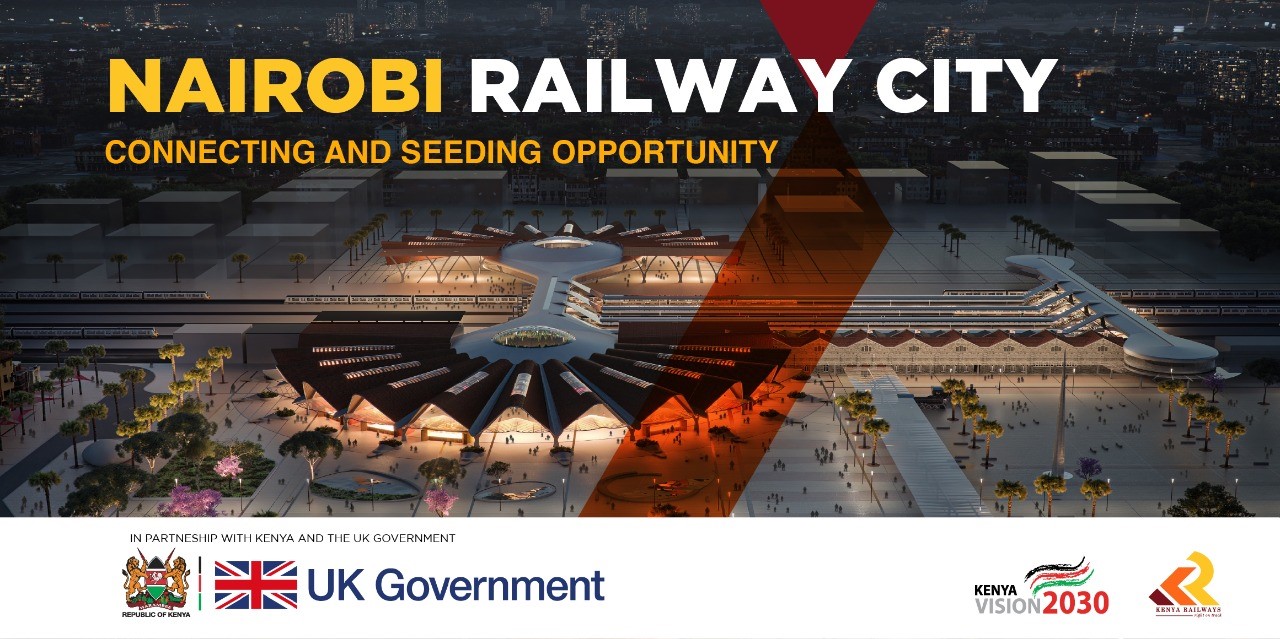
The new Nairobi Central Station and adjacent public realm will be the iconic centerpiece of a new Railway City and the focal point of Nairobi’s new multimodal urban transportation network. The Central Station’s landmark design incorporates the existing stations heritage in a new design that links to and integrates with the existing Nairobi Commuter Rail Service, Public Service Vehicles, Bus Rapid Transport (BRT), Light Rail Transit (LRT), Non-Motorized Transport (NMT) and vehicular traffic.
The ongoing rehabilitation of the Nairobi Commuter Rail will revitalize the service, increasing Central Station’s capacity from 16,000 passengers per day to 30,000 passengers per peak hour.
A modernized central station will help ease CBD congestion by accommodating projected daily footfall of 400,000 by 2030 and up to 600,000 by 2045.
The City’s design promotes environmental sustainability and reusable green energy by embracing nature through its climate responsive design .